

How can we use natural resources to positively impact local communities?
MFC 8.0 - School Year 2025/2026
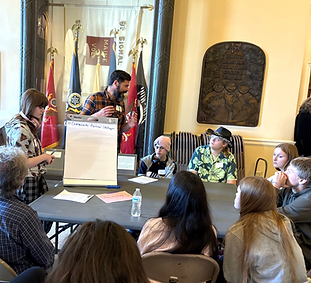
Our first high school cohort day was in early October at the State House in Augusta. We were joined by students from Piscataquis Community Secondary School, Schenck High School, Belfast Area High School, Telstar High School, and Tri-County Technical Center who shared a "Map of Place Poster" highlighting the individuality of each community along with natural resource challenges they have seen in their area. We had amazing support from community partners who worked with students in small rapid prototyping groups to work through challenges and build a solution.
We are grateful to have had the partners below work with students to think about real challenges their sector is facing.
Policy - Olivia Griset, Kaya Lolar, negina lawler-naluai (Maine Environmental Education Association)
Jackson Chadwick (Maine Youth for Climate Justice)
Forestry - Molly London (WW London Woodlot)
Recreation - Brian Threlkeld (Maine Outdoor Brands)
Conservation - John Whittaker (Kennebec Land Trust)
Middle schoolers from Piscataquis Community Secondary School, Greenville Consolidated School, and Tremont Consolidated School connected at the Bangor Recreation Department where in mixed groups they also did some rapid prototyping and designed some innovative solutions to challenges around light pollution, endangered species, increasing participation in outdoor recreation, and invasive species.
High schoolers participated in a second cohort day at the University of Maine where students shared their projects, received feedback, ate at the Bear's Den and participated in one of the following sessions:
-
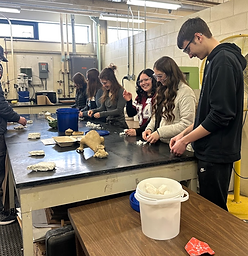
Bioproducts & CNF - Students will learn about and get to create a boat, bridge or buoy with nanocellulose, a, non-toxic bio-based material made of plant fibers that is being researched for use in, products ranging from fire extinguisher foam & replacement bone material, to sustainable, packaging.
-
Hudson Museum & Ash Seed Processing - Students will experience a brief tour of the brown ash basket collection at UMaine's Hudson Museum and learn about the importance of brown ash basketmaking in Wabanaki communities. Next, students will learn about the threat the invasive emerald ash borer, EAB, poses to ash trees across the region and efforts to collect and store ash seed for future forest restoration efforts.
-
UAV & Virtual Room - Monitoring forest health is important to plan for timber harvest, and to watch for diseases and pests. To monitor forests above the canopy, UAVs and satellites can easily capture data. However, under the canopy data collection is still a challenge, because the drone has to detect and avoid, obstacles. That is the problem we are attempting to solve in this lab. In this session, we will show you the drone avoiding obstacles in simulation, our custom-built drone that is facing some engineering challenges, and virtual reality tour of a local Maine forest.
-
Out of the Woods: Making Choices Under Constraint - What should you do when you don’t have enough resources to do everything? Using trees as a shared resource, teams will decide how best to allocate them across competing uses of paper, energy, furniture, and futuristic 3D-printed houses. As new technologies are introduced and constraints bind, every choice involves trade-offs and opportunity costs. With discussion, problem-solving, and lighthearted humor inspired by Taylor Swift’s Out of the Woods, learn how economists think about optimization, scarcity, and decision-making in the real world, no advanced math required, just clear thinking and creativity.
Some highlights of the year include:
-
MFC was embedded in TWO Early College courses this year with UMF under Wildlife Ecology & Conservation at Schenck High School, and the Natural Resources Class at Tri-County Technical Center.
-
5 Schenck students visited UMF in the fall & spent the night
-
MFC hosted Telstar for its first overnight cohort day
-
Piscataquis Community Secondary School and Greenville Consolidated School worked with Amir Colbert-Stone, UMaine graduate student and MEEA Changemaker Fellow on their projects Piscataquis Community Secondary School and Telstar High School received MEEA mini-grants this year to support their project
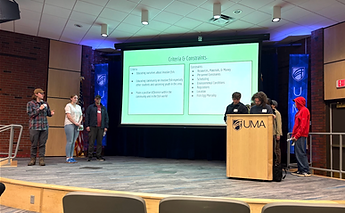
Our high school final cohort day at UMaine Augusta showcased all of the students projects for the year in a final presentation attended by students, teachers, and community partners followed by a debrief and pizza in the student lounge. Thank you to all of our community partners and funders who made this day happen!
Our middle school final cohort day took place at the Innovative Media Research and Commercialization Center at UMaine where 8th graders got to stand up in front of an audience of peers and adults and share their projects for the year. In the afternoon students participated in designing and laser cutting their names into keychains, interviewing students from other schools on podcast recording equipment, and visited the Process Development Center to learn about nanocellulose or visited the Advanced Structures and Composites Center to see the 3D printed house and boat.
Here is a list of projects by school. See each section below for each school's final presentation!





Telstar High School
SEMESTER 1
This first semester's challenge was focused on pollution in local waterways with their challenge question being, "How might we clean up and spread awareness of water pollution in our local waterways so that our wildlife and community can benefit from cleaner water?" Students ended up organizing a bottle drive at school to raise money for the project, testing water quality at local rivers, collecting trash and data on trash at various boat launches, and designing a website with informational flyers to post at local boat launches.
SEMESTER 2
This semester, students began thinking about their interests, protecting old growth forests and land. As serendipity would have it, MFC received an email from Megan Lamb of the Land Use Planning Commission who was looking for increased student engagement with their Comprehensive Land Use Plan. Students were happy to combine their interests with this need with their challenge being, "How might we provide recommendations about enforcing and evaluating rules, regulations, and zoning and how unorganized territories are classified for land use so that we have a balance between conserving land and providing new opportunities for growing communities?" Students ran through scenarios on what it would look like to put in an Aroma Joes in an unorganized territory near an old growth forest, near protected species, and near wetland areas. They provided feedback through these scenarios on rules and zoning regulations in unorganized territories for the Land Use Planning Commission.
Belfast Area High School
Belfast students this year completed MFC as part of an engineering course, this was a first for MFC and provided a really unique take on projects. Their project focused on exploring cellulose nanofiber as a sustainable solution to a product. They landed on looking at its application as a wire coating, with their challenge question being, “How might we compare CNF to conventional materials so that we can determine thermal and electrical conductivity, and flexibility and viability as an alternative coating to rubber electrical wire?”. In addition to various experiments and data collection on the properties of CNF applies as an insulation to wires, students ended up with creating article about their project that is featured on the Process Development Center's website!

Tri-County Technical Center
Stephany Perkins led a second year of Natural Resource students participating in MFC at a technical school. Students connected with over 50 community partners over the course of the year, students won FFA competitions and will be going to nationals again next year, and some even traveled to Iceland over April break!
As a group of students all connected to fishing, this years students explored, "How might we inform people about invasive fish species so that the community can make a positive difference and allow our native species to thrive?" They worked with the local 4th graders on an ice fishing event this winter to provide an informational and fun session and materials on preventing the migration of invasive fish to new water bodies. Students also raised and released trout, and led a second day of open water fishing for 4th graders with various sessions on fishing, boating, invasive species, and macroinvertebrates.


Piscataquis Community Secondary School
Piscataquis students this year explored, "How might we increase Piscataquis area’s tourism and outdoor recreation by creating advertisements for businesses that highlight their outdoor amenities and activities so that more visitors and tourists are encouraged to come visit our local outdoor recreational places, and show support for them?" They focused on two places to advertise for, Big Moose Mountain, and Fierce Chase Trails. Their videos came out EXCELLENT and are featured below:
BIG MOOSE VIDEO
FIERCE CHASE VIDEO


Schenck High School
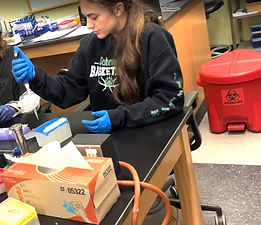
This year Schenck students are exploring, "How might we help design and construct a usable outdoor natural classroom for our elementary students that is safe and can be frequently used to offer structured activities, despite limited funding and unpredictable weather?". They created an outdoor classroom space with benches and a stage along with an outdoor lesson they facilitated for elementary school students.

Greenville Consolidated School
Greenville students this year worked on forest health. Their challenges was, "How might we raise awareness about our local forest health so that we can maintain a healthy forest ecosystem that provides a diverse forest habitat for the community, plants, and wildlife?" The 8th had a few different solutions, including two strategies for raising forest health awareness, educating 5th graders about the importance of ash in our forests, and creating an informational welcome sign on the area for the Natural Resource Education Center. They worked with Amir Colbert-Stone from MEEA, members of the NREC board, District Forester Jim Ferrante and Weyerhaeuser staff.


Tremont Consolidated School
Tremont students took on a big project connected to reduced carbon emission in four ways: energy efficiency, salt marsh grass growing, composting & seaweed growing. They asked, "How might we raise awareness about the environment and what’s happening around everyone so that our community can reduce carbon dioxide emissions and waste and decrease the effects of climate change?" One of their biggest accomplishments was completing an energy audit for the school and providing recommendations for energy saving solutions to the school board.

Piscataquis Community Secondary School 8th Grade
Piscataquis students challenge took their to their own schoolyard to explore, "How might we educate people on how and why utilizing maple trees is important so that we can share resources with the community, learn a future skill, and set up the community for self-sufficiency?" They worked closely also with Amir Colbert-Stone and District Forester Jim Ferrante on their project. They ultimately tapped maple trees and made syrup, created an informational brochure about how to tap maple trees, and held a community pancake breakfast to be able to bring the community together and provide education about utilizing forest resources where they raised money to go toward a local school supporting organization called HUGS.

