top of page


How can we use natural resources to positively impact local communities?
MFC 7.0 - School Year 2024/2025
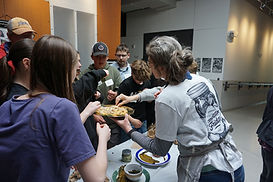
2024 started off jumping right into Maine Forest Collaborative. Our first high school cohort day was in late September at the Maine Local Living School where students got to connect with natural resources first hand, learn about how forests can be used for non-timber forest products and long term management. Students practiced stripping bark for poles for wooden structures, carved wooden spoons, learned about forest management, and got to prepare wild edibles.
Middle schoolers connected at the University of Maine where they got to practice Rapid Prototyping, build an Aquaponics tank, tour the Process Development Center and learn about nanocellulose, and tour the Advanced Structures and Composite Center.
Some highlights of the year include:
-
Schenck High School in East Millinocket re-joined as part of UMaine Farmington's early college course Wildlife Ecology & Conservation.
-
Tri-County Tech Center was the first technical school to join MFC as part of its Natural Resources class.
-
Greenville Consolidated School transitioned its MFC program to pilot an adapted middle school program with Tremont Consolidated School on Mount Desert Island.
-
Belfast Area High School, Ecology Learning Center, Piscataquis Community Secondary School, and Telstar High School returned to MFC this year.
-
MFC students from Piscataquis and Schenck participated in their first overnight cohort day experience at the University of Maine.
-
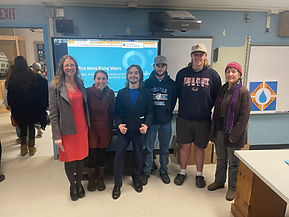
We had a local final presentation at Telstar High School attended by the entire 7th grade team, the superintendent, and community partners.
-
Tremont 7th and 8th grade classes received an almost $5,000 grant from Gulf of Maine Research Institute for their salt marsh restoration project
-
Tri-County Tech Center & Greenville established FERN plots
Our mid-year high school cohort day was held at the University of Maine where students shared and learned about their rural communities, learned about environmental AI and got to play tic-tac toe with a robotic arm, and learned about nanocellulose in a tour at the Process Development Center. 21 students from Schenck and PCSS got to extend the day with an overnight where they climbed on the climbing wall, toured campus, ate at the Bear's Den, built a blinking LED light, met with professors and undergraduate students from the School of Forest Resources, and got to see a show at the Planetarium.
Our high school final cohort day at the Maine Academy of Natural Sciences showcased all of the students projects for the year in a final presentation attended by administrators and community partners. In afternoon sessions, students learned about mushroom log inoculation, aquaculture, blacksmithing, woodworking, and pickling from MeANS teachers.
Middle schoolers presented their final projects at the Innovative Media Research and Commercialization Center at UMaine where 8th graders got to stand up in front of an audience of peers and adults and share their projects for the year. In the afternoon students participated in designing and laser cutting their names into keychains, interviewing students from other schools on podcast recording equipment, and learned how they can ferment seaweed to create sauerkraut.
Here is a list of projects by school. See each section below for each school's final presentation!


.jpg)
.jpg)

_JPG.jpg)
_JPG.jpg)
_JPG.jpg)

_JPG.jpg)

Telstar High School
SEMESTER 1
After historical flooding in winter of 2023, Telstar students felt that there were challenges in their community around inland flooding and preparedness. We worked with Center for an Ecology Based Economy's (CEBE) Roberta Hill to create the first inland flood community science protocol for Gulf of Maine Research Institute, modeled off their coastal flooding protocol. Students learned a lot about historical floods in the area and the lack of communication strategies for letting the community know about flooding. In addition to the protocol students came up with a poster local businesses could put up in case of flooding and a flood preparedness checklist. This video featuring student's work was published on CEBE's page as well.

SEMESTER 2
This semester, many of the students in Telstar's Environmental Policy Class liked to fish. The class learned some interesting information with help from Nick Kalejs from Maine Department of Inland Fisheries & Wildlife about a unique subpopulation of white fish in their local pond, and threats from non-native smelt in landlocked ponds. Their solution was to create an share an awareness campaign about the fish through a newspaper article and YouTube video they created and filmed.

Belfast Area High School
Belfast Fish & Wildlife students worked closely with Aleta McKeage, environmental scientist to learn about ecological restoration and how they could make improvements to the school grounds. They did some work at Wales park eliminating invasives and then underwent the same Conservation Checklist and process used there for finding problem species on campus.
Different groups of students focused on different solutions, including removing glossy buckthorn, multiflora rose, and Japanese barberry, sowing native wildflower species, building a wildflower garden bed, and building a picnic table. One group also wanted to increase biodiversity by planting apple trees, but the donation we requested was not approved.
Tri County Technical Center
Stephany Perkins led this year's first round of Natural Resource students on MFC's first implementation in a technical school. Students connected with over 50 community partners over the course of the year, visiting sites local maple sugar houses to cross country skiing with AMC. Early in the year it was discovered that the school owned a woodlot that was not used and very little information was known about it.
Over the course of the year students work with land surveyor Levi Ladd to map out the property boundaries, find the old tax maps and re-establish boundaries. Their project landed on beginning to develop their own forest management plan fpr the property.
TCTC students also placed first and second at the Future Farmers of America competition and will be heading to nationals in the fall! They also completed their Wilderness First Aid Certification, and chainsaw safety, among TONS of other skills.


Schenck High School
Schenck students kicked the year off with a pre-first cohort day overnight visit to UMaine Farmington where they got a campus tour, were able to participate in a college class dragging ticks, and eat on campus. Throughout the year students worked most closely with Outdoor Sports Institute's Dan Rogan who helped them on their project's path of expanding awareness of outdoor recreation opportunities in the Katahdin area. They developed a website to be able to share opportunities and secured a grant for the next years class to be able to obtain equipment to revive the trail behind the school.

.jpg)
Piscataquis Community Secondary School
Piscataquis students were in a unique opportunity this semester, as a neighboring land owner with a passion for outdoor education offered to lease their land to the school to use for educational purposes for $1/year for the next 10 years. Students developed a vision for what they wanted to see this land used for. As students got into the semester, we learned that the property owners wanted to wait until the lease was finalized before any work was done on property. This led to a project pivot where students started to work on a trail leading up to the property. This included building a bridge, working on trails, building a campsite and fire pit on school property.
Greenville Consolidated School
Greenville students this year worked on forest health. The 8th graders tackled this challenge with a few different solutions, including establishing a FERN plot at their school, spreading awareness in the community/at school of invasives, removing invasive Norway maple and shrubby honeysuckle on campus, and increasing biodiversity by planting native cedar trees and wildflowers. They worked closely with District Foresters Jim Ferrante and Kenny Fergusson. Check out this press release about the project!
.jpg)
.jpg)

Tremont Consolidated School
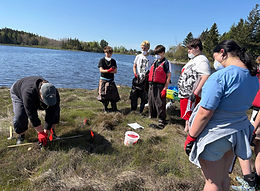
Tremont students this year tackled a big project - combating sea level rise through salt marsh restoration. Students worked closely with Tatia Bauer of Maine Coast Heritage Trust on a variety of different solutions to this challenge. We are grateful to have received funding from the Gulf of Maine Research Institute to purchase 1000 native salt marsh grass plugs. Students designed experiments on some of them to find optimal growing conditions before planting them in Babson Creek Marsh, a MCHT property. Tremont students are lucky enough to have a salt marsh in their backyard with parts of Acadia right next to the school. Students also established 6 feldspar monitoring plots with permission from Acadia National Park to measure soil accretion in the marsh over time and track growth within the marsh. Here is a news article about the project!


bottom of page